Clinically Reviewed
compassion focused therapy (CFT) for Sleep

When sleep is difficult, it's very easy to become frustrated and annoyed with ourselves at night and during the day afterwards. We might find ourselves thinking the following:
Why can't I do something that everybody else seems to find so easy?
Why am I still awake again?
What am I getting wrong with sleep?
Why is nothing working for my sleep?
It's easy to end up in a position where we're tired, worried about tomorrow after another bad night and trying hard to find something that actually helps our sleep. Then our minds add another problem: the idea that struggling with sleep says something negative about us and is something that we're getting wrong and failing at.
Compassion Focused Therapy, usually shortened to CFT, offers a way of understanding these common reactions and responding to them with more care towards ourselves and less criticism, shame and blame. Developed by psychologist Professor Paul Gilbert, it explores how our minds respond to threats, such as the threat of not sleeping, and why self-criticism can become so prevalent in these situations. Instead CFT is about how we can develop a more supportive and kinder relationship with ourselves, especially during difficult periods.
For sleep, this means understanding the worry, pressure, anxiety and self-blame that can happen to us when we constantly find it difficult to sleep. Alternatively we can then learn new ways to respond which support ourselves and move towards better rest, not more struggle at night.
At Sluzzle, CFT is one of the main psychological approaches our clinicians draw on for helping sleep difficulties, alongside Acceptance and Commitment Therapy, or ACT.
What is Compassion focused Therapy?
Compassion Focused Therapy is a psychological approach that helps people understand and work with difficult emotions, shame and self-criticism. It combines an evolutionary understanding of the mind with practices for developing compassion towards ourselves and others.
Compassion here means recognising suffering and being motivated to help relieve it. It involves understanding what is difficult, having the courage to engage with it, and considering what would actually be useful to do next. Dr Will Devlin describes it simply: “Compassion is about noticing difficulty and doing something about it.”
That can be particularly relevant when sleep becomes difficult. You aren't able to choose whether you fall asleep at a particular moment or how many hours you sleep each night, but you can begin learning to respond to being awake, and any struggles and difficult emotions that this brings with it, in a more helpful way.
Compassionate mind training is the practical skills side of this approach. It can include developing attention exercises, soothing rhythm breathing, compassionate imagery and developing a kinder, wiser inner voice. These are skills to explore and take time to practise, rather than being another set of rules you have to get right or perfect straight away.
Compassion also begins with understanding our “tricky brains” and how they've evolved to be difficult to live with. The same essential abilities that help us to plan actions, remember things and imagine scenarios can keep mental distress going when there is actually no direct threat to solve immediately, only hypothetical ones. We can lie in bed remembering yesterday's difficulties after a bad night of sleep and imagine and catastrophise about tomorrow's. Our bodies respond to the worry happening now and this often presents itself in feelings such as stress, anxiety and frustration. In CFT, understanding this pattern helps to take some of the blame out of the situation we find ourselves in.
You did not deliberately choose to become anxious about sleep each night or day, our evolved "tricky brains" did over a short period and they only did so because their wired to detect threats, such as not sleeping at night, and try to solve them. CFT is partially about learning to recognise these patterns and work with them in a different and more kinder helpful way.
The three emotional systems in compassion focused therapy
A central CFT model describes three interacting emotional systems: the threat, drive and soothe systems. Sometimes called the three-circle model, it offers a useful way to understand different emotional states. It is a simplified map of how we naturally respond to circumstances, rather than three actual separate compartments in the brain.
All three states have useful functions for us in many different contexts of life. An aim of CFT is to get better at recognising which system is dominating at any one point in time and then develop more flexibility in how we then continue to respond.
The Threat System
The threat system helps us to detect danger and protect ourselves from threats, including emotional ones too. It is associated with feelings such as anxiety, anger and shame, and typical responses include becoming vigilant, aggressive, withdrawing, stressed and preparing to act defensively.
With sleep, the danger your mind is responding to may be an imagined catastrophic tomorrow and worst case scenario future.
What if I can't concentrate tomorrow?
What if I lose my job / relationship etc if I continue not sleeping?
What if I let somebody down tomorrow when I'm tired?
What if tonight is another difficult night?
Dr Shelley Kerr explains how negative thoughts and emotions can feed each other and spiral. Worry creates a sense of threat, that sense of threat then makes the mind focus more on possible problems, overthink, and then the worries keep coming.
Being caught in that loop is uncomfortable and very common. Understanding how we often we easily end up in these loops can help us to learn why it happens, what we can do about it, and without treating it as a personal failing.
Threat can also turn our attention towards signs that the night is going wrong and will be another problem or disaster. When the threat system takes over you notice how alert you feel, listen for every sound and may repeatedly calculate the time left before morning or wake up time and how much sleep you could get. Each check may be an attempt to reassure yourself, but it can keep attention fixed on the very thing you're fearing, i.e. not sleeping.
CFT encourages us to stand back and notice that inherent protective intention we have, alongside the effect it is having on is. By starting to notice it, we start to create a bit of distance to allow us to respond differently and not on auto-pilot.
The Drive System
The drive system motivates us to pursue the things that we want in life. It helps us achieve, solve problems, find resources and keep going, which is generally a really useful set of traits in life. It can be really helpful and bring us enthusiasm, encouragement and energy when we need it most.
The difficulty comes when sleep turns into a goal or an achievement that we're striving for.
I need to get eight hours sleep.
I need to find the right relaxation technique.
I must find a solution to my sleeping problems.
Dr Will Devlin explains that wanting sleep is what can pull us into striving for it and subsequently add the pressure. We try harder, monitor the results and become frustrated when our efforts don't produce sleep or the results we expected and wanted. A proactive driven approach that helps us to finish an important work project can also be the approach that may keep us too mentally engaged when we want to rest.
Drive can ultimately pile on the pressure around sleep and backfire. We end up pursuing all sorts of fixes, solutions and attempts to control and force sleep, hoping to make it more predictable and garaunteed. When actually the urge and fixation to achieve sleep can be the very thing keeping us alert and awake.
The Soothing System
The soothing system is associated with contentment, connection and a felt sense of safeness. It supports the experience of being able to settle and feel at ease without feeling the need to have to achieve something or defend ourselves.
Dr Shelley Kerr describes how comfort, caring relationships and soothing sensory experiences can help us access this state. For one person that might be the warmth of a blanket. For another it might be a familiar voice, gentle touch or a reminder of someone who cares about them.
CFT explores ways to make this soothing capacity much more available to ourselves. It's about learning how to support yourself when things are difficult and be kinder and more compassionate towards ourselves, without requiring a particular feeling or sleep to appear immediately.
You can feel very tired and still lie awake worrying at night, with your mind racing and your body feeling tense. CFT explores ways to respond to that distress with care and understanding. This includes noticing how you speak to yourself: a gentle, supportive response to being awake may help ease the pressure, whereas criticism and demands to fall asleep can add to it.
Why can trying harder to sleep keep threat and drive active?
Imagine you are lying awake in the middle of the night and worried about an important meeting the next day. Your mind notices a problem: you need to sleep well in order to feel at your best for tomorrows meeting. Then the Drive system gets involved and starts searching for a solution to the problem. You keep checking the time, tossing and turning, trying to force yourself to relax and checking whether or not you're asleep yet.
When you remain awake, the threat system then adds another message: Something is wrong. Tomorrow will be awful. You need to fix this now.
Will and Shelley both describe how we can become caught between striving and surviving. Wanting sleep leads to more effort and pressure; difficulty sleeping leads to more worry, anxiety and frustration; and the combination leaves little room to settle and let sleep happen naturally.
Recognising when you're in the middle of this pattern gives you another possibility: You can notice that your mind is trying to help by overthinking, which may be coming from the threat and drive system, acknowledge how hard the night feels (you're not trying to sugar coat it), and consider whether another round of your mind checking or problem-solving is useful right now.
CFT includes exercises such as soothing rhythm breathing and compassionate imagery, where you bring to mind a supportive person or a place associated with feeling safe and cared for. These practices can help you respond more gently to a difficult night. However, they can also become part of the same cycle of effort and pressure if you start thinking: Am I doing this properly? Why hasn't it made me fall asleep yet? The aim is to practise supporting yourself when you are struggling, without turning the exercise into another task you must get right to make sleep happen.
self compassion does not mean giving up on better sleep
People sometimes worry that being kinder and gentler to themselves means letting things slide, giving up and resigning yourself to difficulty sleeping. If I stop pushing myself, won't I stop doing anything about the problem and hence I'll be stuck with it?
Dr Shelley Kerr makes an important distinction here: compassion involves engaging wisely with difficulty in a way that's actually helpful. It can include seeking support, making changes and doing things that take courage. It's not giving up on a helpless situation.
At night, that might mean acknowledging that you are awake, distressed to some extent and it's not easy, without adding that you are useless or broken. During the day, it might mean asking for others help or taking a manageable step towards something important, even if you're tired.
You can want sleep to improve while also recognising that punishing yourself for struggling and working yourself up about it is unlikely to be a helpful starting point or tactic going forward.
Think about helping someone you care about through a difficult day. You might acknowledge their distress and help them to soothe, cone to terms with things and settle. You would probably allow for their circumstances rather than demanding that they cope perfectly and just "get on withit". Self-compassion involves bringing that same understanding into the decisions you make about yourself.
Why you can be safe in bed, but still feel threatened at night
You may know that your bedroom is perfectly safe at night and still feel tense, restless or on edge. Knowing there is no immediate physical danger does not always produce a felt sense of ease.
Shelley uses this distinction to explain why developing soothing skills deserves attention in its own right. It can be useful to explore what genuinely helps you to feel supported and connected, rather than repeatedly telling yourself that there's nothing to worry about.
Will explains that our minds can generate a sense of threat through what we remember and imagine. You might be lying in a quiet bedroom while mentally rehearsing tomorrow’s potential problems, replaying an uncomfortable conversation or worrying about the consequences of another sleepless night. Those thoughts can stir up anxiety and physical tension even though nothing dangerous is happening around you.
Sleep itself can then become part of what feels threatening. If you are worried about being awake, noticing that you still haven’t fallen asleep gives your mind another reason to sound the alarm. You become more alert, notice your wakefulness more and feel increasingly frustrated or afraid.
This helps explain why simply telling yourself that you are safe may not be enough. Your bedroom’s safety does not resolve the concerns your mind is responding to when awake at night. CFT helps make sense of that response: feeling on edge in bed may be because of how your threat system is responding to what being awake has come to mean to you.
Shelley's restt framework for difficult nights
Shelley's Sluzzle course brings compassionate responding into five practical steps, which form the RESTT framework. This is her way of organising the skills into a way that may be helpful when someone is struggling with sleep.
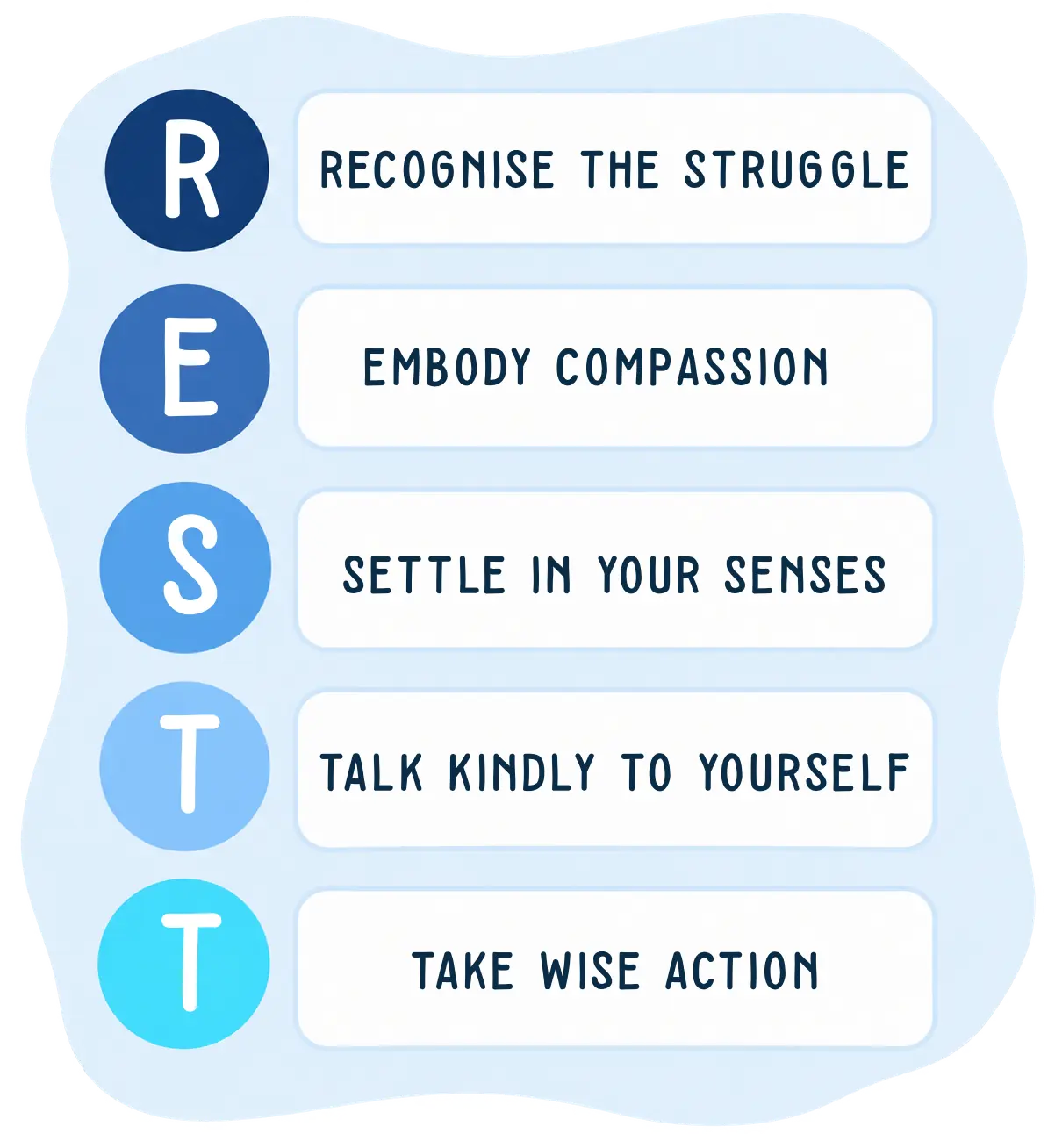

Recognise suffering
Notice what is difficult and name it. Perhaps you are anxious about tomorrow, frustrated by being awake or upset by how long sleep has felt hard. Simply recognising this can create some needed distance and interrupt the automatic rush to fix it.
Embody Compassion
Bring an intention to support yourself in a kind manner. Shelley describes this as approaching yourself as someone worthy of care and support. You don't have to feel nice about yourself immediately to begin, it's about starting and acting with that intention.
Settle in your senses
Explore a grounding point in your sense: the support of the mattress or chair, a sound nearby, or the warmth of a hand resting comfortably on your chest. Allow your breathing to find a comfortable rhythm, without forcing it.
When your attention wanders back to worries about tomorrow, gently return it to that sensory point. Wandering is expected; noticing and returning is the skill. Soothing rhythm breathing follows a similar principle: explore a comfortable, unhurried rhythm, rather than trying to take the biggest breath or meet an exact count.
Talk kindly to yourself
Consider how you would speak to a friend having the same difficult experience. You wouldn't blame them or get annoyed at them. Instead you might acknowledge: This is a hard night and can't be easy. I can understand why you're upset. You don't have to get frustrated with yourself for being awake.
Equally we know when we're struggling sometimes the last thing we want a friend to do is try and "fix" the problem. Sometimes we just want to be heard and supported.
Take wise action
Ask what would be a helpful next action in the circumstances you're in. Perhaps it's stepping back from clock-checking, asking for support the next day, even doing nothing and just resting or choosing one realistic activity that matters to you the next day and is worth showing up for regardless of the night. Compassion very much includes what you do as well as what you say.
how does CFT address racing thoughts and the inner critic
At night, a worrisome thought about tomorrow or the future can quickly become a judgement about yourself. "I'm awake again" turns into "I can't even get sleep right".
Will describes how the inner critic can add to our sense of threat. Shelley encourages looking beneath its words: what is this critical part of you afraid might happen if things with sleep continue as they are? Perhaps it fears failure, disappointing somebody or being unable to cope.
You can take the concern seriously without accepting the attack. A more compassionate response might be: I can see I'm worried about tomorrow. Calling myself useless or hopeless won't do anything to help me in this situation.
This also helps explain why simply arguing with the critic can become exhausting. You may spend the night trying to prove that what you're trying will work, while your mind keeps supplying another objection. Looking beneath the criticism changes the conversation: what is the worry, and what understanding or practical support would help you at that moment?
Both clinicians use something called compassionate letter writing. You can write to the struggling version of yourself from a wiser, more supportive perspective, acknowledging the difficulty and offering understanding or helpful guidance. Will also suggests alternatively recording a voice note if writing feels less natural.
A letter can be brief and specific. Acknowledge what has been happening, recognise why it hurts and offer one realistic piece of encouragement and kind supportive words. Read it back with attention to its tone. Does it sound like someone offering help, or has another demand to do better slipped in? You can revise it with that in mind.
compassion is also about the day after a difficult night
After poor sleep, it is easy to spend the day revisiting the previous bad night, feeling hopeless and or worrying about the next night. A compassionate approach asks what support you need in that moment and what is realistically manageable. That could mean adjusting an expectation, taking a break or keeping to a small plan, even if it's not easy, that gives the day meaning and purpose.
Shelley connects compassionate action with values: the people, activities and qualities that matter to you. You might still see a friend for a visit, spend some time outside on a walk in nature or ask somebody to help with a demanding task that you need to do.
The response can change depending on the circumstances. There is a balance between adapting to a difficult day and deciding in advance that nothing worthwhile is possible or doable. You can ask what needs adjusting depending on how tired you feel and what you would still like to crack on with in your daily activities that really matters to you. That gives you a more flexible starting point than either pushing through everything or abandoning every plan.
How Sluzzle's CFT clinicians approach sleep

Dr Shelley Kerr and Dr Will Devlin lead Sluzzle's CFT-focused courses. Compassion also appears throughout our other clinicians' ACT-based guidance, with different ways of helping you respond more supportively to difficult nights.
Dr Shelley Kerr: become someone who has your own back
“I want to be helpful, not harmful.”
Shelley uses this intention when introducing compassionate responding. Her course combines understanding the mind with sensory grounding, a supportive inner voice and wise action. A useful starting question is how you would respond to a friend in the same situation, and whether you can offer yourself some of that care.
Dr Will Devlin: understand your tricky brain
“Compassion is about noticing difficulty and doing something about it.”
Will explains why a mind that is good at detecting problems can become caught in worry and striving around sleep. His compassionate mind practices help you develop a supportive perspective from which to respond, including when your inner critic is loud.
Dr Charlie Tyack: compassion is something that you practice
“Compassion is a practice, not a kind of end point, not a tool that needs to be perfected.”
Charlie suggests describing a night as hard or difficult, and considering how you would speak to a friend who had experienced it. A change in tone can help reduce the pressure you place on yourself.
Dr Jill McGarry: acknowledge that the night is hard
“We want you to be okay and be kind to yourself.”
In her explanation of acceptance, Jill acknowledges how tough and lonely wakefulness can feel. Her point is to allow that experience some space before rushing into another attempt to solve the night.
Dr Amanda Mwale: make room for kindness when you are awake
“May I be kind to myself in this moment of suffering.”
Amanda uses this phrase in a loving-kindness exercise. She encourages people to choose words that feel natural, making room for the loneliness or frustration of wakefulness while responding with care.
Dr Zoe Gotts: sleep does not define you
“Poor sleep doesn't define who you are.”
Zoe brings self-compassion together with living according to your values. Her closing guidance encourages treating yourself more kindly and remembering that your identity and life extend beyond how you slept.
Is CFT just relaxation and positive thinking?
No. CFT can include practices that feel calming, but its scope is much wider. It helps you understand emotional patterns, engage with difficult experiences in a more helpful way and choose a better response.
Shelley points out that automatically telling a struggling friend to focus on the positives could feel dismissive. Compassion begins by recognising that something is hard.
It also does not require every exercise to make you relaxed. If you start checking whether you are soothed enough to sleep, the practice can become another achievement to chase or goal that you are trying to achieve. You can notice that pressure with the same understanding you are trying to develop elsewhere.
What does the research say about CFT and sleep?
A 2024 series of meta-analyses covering 47 controlled trials found benefits of CFT for outcomes including self-criticism, depression and compassion. Sleep-specific research includes a 2020 synthesis of nine studies from one German research programme. It found an association between greater self-compassion and better self-reported sleep quality, alongside promising short-term experimental findings. A 2026 randomised pilot explored ACT combined with behavioural sleep strategies and self-compassion. Its analysed sample contained 19 people. Together, these findings give a reason to explore compassion in sleep support.
How do ACT and CFT work well together for sleep?
ACT and CFT have complementary aims and skill sets. ACT helps you become less caught up in thoughts, make room for difficult experiences and keep moving towards what matters. CFT brings particular attention to the way you relate to yourself while doing that.
At 3am, ACT might help you notice that your mind is predicting disaster. CFT might help you recognise how frightened or alone you feel and respond with a more supportive tone.
The next day, ACT can help you choose a manageable action linked to your values. Compassion can help you approach that action with realistic expectations and care for your tiredness.
This matters because even useful psychological ideas can become demands. You might start telling yourself that you should be better at acceptance, or criticising yourself for getting hooked by a negative thought again. A compassionate approach helps you notice that extra pressure. You are learning skills while already having a difficult time, and you will sometimes get caught up. You can acknowledge that, offer yourself some understanding and choose your next step without needing to get the whole approach right.
A 2023 paper sets out a rationale for combining ACT, self-compassion and behavioural insomnia strategies, and the 2026 pilot begins to explore that combination clinically. This supports describing the approaches as complementary.
You can read more about Acceptance and Commitment Therapy for sleep in our companion article.
How Sluzzle uses cft for sleep
Sluzzle offers clinician-led courses with different ways of exploring your relationship with sleep. Shelley and Will's CFT-focused courses explain why difficult nights can activate worry, striving and self-criticism, and introduce practices for responding with more understanding and support.
Alongside our ACT-based courses, they offer ways to make sleep feel less pressured and to give more attention to the life you want to lead.
You do not have to become perfectly compassionate. You can begin by noticing a difficult moment and asking what a helpful response to yourself might look like.
Scientific studies on cft for sleep
1) ACT combined with behavioural strategies and self-compassion for insomnia ; Miller-Mendes et al ; British Journal of Clinical Psychology ; June 2026
2) Meta-analyses of compassion-focused therapy outcomes ; Petrocchi et al ; Clinical Psychology: Science and Practice; 2024
3) Why combine ACT, self-compassion and behavioural sleep strategies; Miller-Mendes et al. ; New Ideas in Psychology; April 2023
4) Self-compassion and sleep quality across nine studies ; Butz and Stahlberg; Behavioral Sciences; March 2020.

Next Steps
learn from experts without the waiting list.
Self-guided, clinician-led courses you can explore at your own pace.


5-day Free Trial
5-day Free Trial
Free 5-Day Trial
Full access free for 5 days
Full access free for 5 days
Then £45 per month
Then £45 per month
Cancel anytime
Cancel anytime
One month may be enough time.
Continue only for as long as you want to.
Simple to do ~ 10 minutes a day
70+ expert clinician video sessions
Access all 7 clinician courses
Grounded in decades of research
Please note: Sluzzle is not designed for sleep disorders. If you are concerned that an underlying condition may be affecting your sleep, please speak with your GP.
Please note: Sluzzle is not designed for sleep disorders. If you are concerned that an underlying condition may be affecting your sleep, please speak with your GP.
An ACT & CFT based approach helping you to improve your relationship with sleep.
Sluzzle offers educational help for everyday sleep challenges and isn’t designed for medical sleep disorders.
©2026 Sluzzle - All rights reserved. Address: 3rd Floor, 86-90 Paul Street, London, EC2A 4NE
An ACT & CFT based approach helping you to improve your relationship with sleep.
Sluzzle offers educational help for everyday sleep challenges and isn’t designed for medical sleep disorders.
©2026 Sluzzle - All rights reserved. Address: 3rd Floor, 86-90 Paul Street, London, EC2A 4NE
An ACT & CFT based approach helping you to improve your relationship with sleep.
Sluzzle offers educational help for everyday sleep challenges and isn’t designed for medical sleep disorders.
©2026 Sluzzle - All rights reserved. Address: 3rd Floor, 86-90 Paul Street, London, EC2A 4NE